Data visualization in a time of pandemic - #3: Mapping the virus
This is a multi-chapter post!
- Chapter 1: Finding reliable data
- Chapter 2: Visualizing exponential growth
- Chapter 3: Mapping the virus
- Chapter 4: We need to talk about flattening the curve
- Chapter 5: On top of the outbreak with daunting dashboards
- Chapter 6: Viral scrollytelling

Chapter 3: Mapping the virus
A pandemic has a strong geographical factor attached to it, so obviously we are drawn to using maps to visualize how the virus is spreading. Both data visualizers and their audience simply love maps, and I personally do to. As a child, my (geographical, historical, biological, even biblical) atlases where my favourite books and I could browse through them for days. However, pretty as they may be, maps have their own pitfalls and caveats. So be prepared!

Beauty in times of despair
Let’s start with some of the most well-designed examples of maps I have encountered during my research for this chapter. The absolute winner, in my opinion, are these clean but very effective maps by the Washington Post:
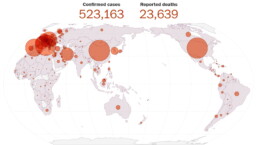
Map showing the global spread of the coronavirus on March 27, 2020 (Washington Post).
To further clarify things, these maps are complemented by a simple table detailing the exact number of confirmed infections or deaths. This gives the reader the choice to look at the broader picture, dive into the detailed numbers, or both.
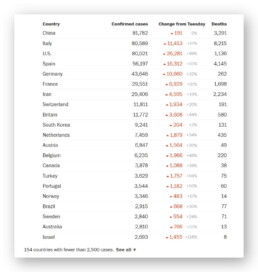
Table showing the global spread of the coronavirus on March 27, 2020 (Washington Post).
It should be noted that the BBC uses very similar, equally beautiful maps. These are examples of proportional symbol maps, or what most normal people simply call bubble maps. But why exactly do these bubble maps work so well?
Mapping issues

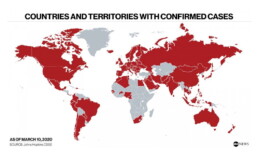
Countries and territories with confirmed cases on March 10, 2020 (ABC News).
Although somewhat helpful, such a map may say more about how connected a country is to the rest of the world, rather than showing how the virus has spread. In any case, it does not provide information about the number of cases. From this map on March 10, we cannot deduct that there was only one confirmed case in Burkina Faso, but over 10.000 in Italy, and over 80.000 in China.
A typical approach to avoid this issue are choropleth maps, a complicated name for something very simple. Blame the Greeks, choros means ‘region’ and plethos means ‘multitude’, hence the name. My scientific brain always tricks me into saying ‘chloropleth maps’, probably because it thinks about chloroplasts in plant cells. But don’t get your hopes up, there’s no connection at all — just my stupid brain. The ‘chloro-’ in chloroplasts also comes from Greek, but from chloros, ‘green’. The same origin, it turns out, as chlorine (because of its pale green color) or chloroform (which contains chlorine). But my apologies, I digress… I might have been reading too much Stephen Fry lately, who would probably love this kind of etymological exploratory ramblings.
So, a choropleth map. In such a map, regions are again colored, but the value of the color (lightness or darkness) depends on the underlying parameter, for example the number of infections in a country. In its most basic form it looks like this example by CNBC:
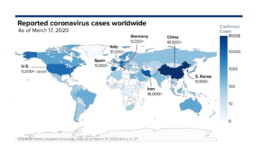
Choropleth map of reported coronavirus cases worldwide as of March 17, 2020 (CNBC).
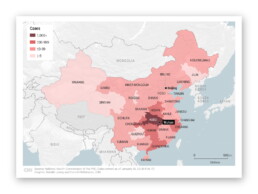
Choropleth map of the spread of the coronavirus in China as of January 26, 2020 (CNN).
However, choropleth maps have their own unfortunate downsides and pitfalls. I will not go into much detail here, as everything was already written down excellently by ‘cartonerd’ Kenneth Field. Let me just summarize:
- choose your colors or color scheme responsibly,
- choose your categories responsibly, and
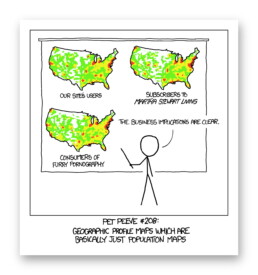
- use relative numbers to avoid population density distortion.
Or, just maybe, a bar chart might be a better choice:
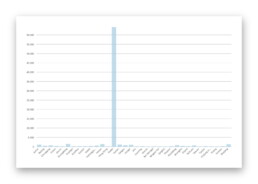
🎵 The map isn’t the best way to show your data, so the bar chart is where I go. (Source: Kenneth Field)
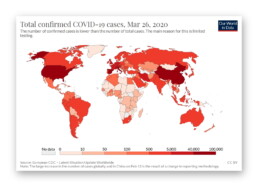
Choropleth map of the total confirmed COVID-19 cases as of March 26, 2020 (Our World in Data)
Bubble maps, such as the ones by the Washington Post shown above, avoid this trap because each nation gets its own bubble, independent of area, population, or population density. This is what makes this kind of chart so successful to map a wide range of values in a wide range of countries around the globe.
There is only one minor downside: bubbles can start overlapping each other when two neighbouring regions have very large values (or one of them has a large value while the other only a small one). Then your bubble chart might start looking like this:
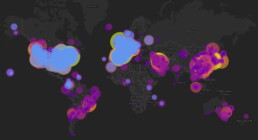
Bubble map on the nCoV-2019 Data Working Group dashboard.
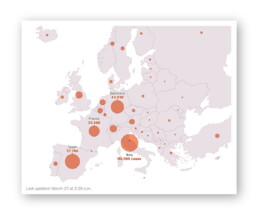
Bubble chart showing confirmed coronavirus cases throughout Europe as of March 27, 2020 (Washington Post)
The return of the table
I already hinted earlier that in some cases, a simple bar chart might be a better option than a complicated map. As Leonardo Da Vinci said: “Simplicity is the ultimate sophistication” (except that he never said that). Another simple but effective alternative might just be… a table.
Many great examples can be found, including the Washington Post ones at the beginning of this chapter, but I was particularly charmed by the Datawrapper ones by Lisa Charlotte Rost, with a clever use of color to bring a touch of optimism to this heavy subject matter:
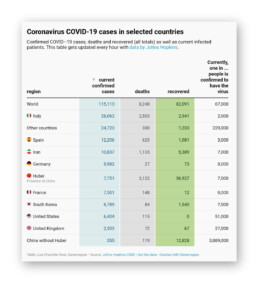
Datawrapper tables by Lisa Charlotte Rost (screenshot: March 18, 2020).
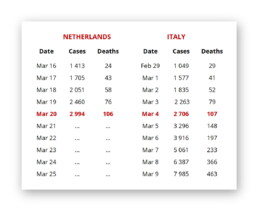
Table comparing the number of infections and deaths between the Netherlands and Italy.
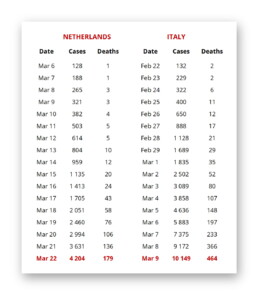
Same data (well, more or less), different story.
Also, differences in age distribution among the population have an impact on the death rate, so it’s rarely a good idea to blindly start comparing different columns or rows with each other, without thinking things through. Remember: if creating panic is your goal, you will always find some data somewhere presented in such a way that you can do so.
There are many, mány more amazing things you can do with tables, also in coronavirus times, but that will be something for another chapter!
Nightmare maps


BBC, by the way, has written an interesting story on an old map showing air travel routes going viral (pun not intended) and causing panic because of poor journalism, such as this badly chosen tweet by the Sun:
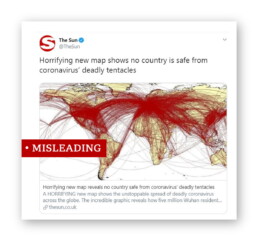
Journalism: you’re doing it wrong.
Finally, if you would ever think about using a pie chart as an alternative to a map… just don’t:
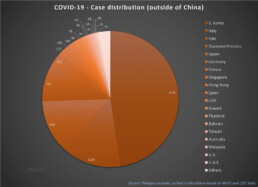
I like pies — Pecan pie! Frangipane pie! Key lime pie! — but not this kind, thanks. (Source: European Scientist)
This is a multi-chapter blog post!
Continue reading:
- Chapter 1: Finding reliable data
- Chapter 2: Visualizing exponential growth
- Chapter 3: Mapping the virus
- Chapter 4: We need to talk about flattening the curve
- Chapter 5: On top of the outbreak with daunting dashboards
- Chapter 6: Viral scrollytelling
For all your comments, suggestions, errors, links and additional information, you can contact me at koen@baryon.be or via Twitter at @koen_vde.
Disclaimer: I am not a medical doctor or a virologist. I am a physicist running my own business (Baryon) focused on information design.
Read more:
How to create a graphical abstract
Graphical abstracts are becoming more and more important. Journal publishers such as Elsevier encourage you to create a concise visual summary of the main findings of your research. But where to start? What steps should you follow to create the perfect graphical abstract for your article? What tools can you use?
Behind the maps
In the 30-day Map Challenge, you are challenged to design a new map every day around a certain topic. I participated in November 2020, and wrote this post to share my thought processes, data sources, tools and results!

Data visualization resources: all the links you’ll ever need!
You want to start creating clear and attractive data visuals, but don't know where to start? No worries, here's a complete overview of tools, resources and inspiration you can use as a starting point for your designs.

Storytelling with Data: Dataviz book review
The Storytelling with Data book has been on my wishlist as long as I can remember, because so many people recommend it as one of the must read dataviz books. So let's see what the fuzz is all about - here's my review!
Uncommon chart types: Slopegraphs
Slopegraphs appear in 'serious' newspapers, but they are very easy to create yourself. Use them if you want to compare how values have changed between two different points in time!
Data visualization in a time of pandemic – #6: Viral scrollytelling
In this final chapter, we’ll dive deeper into some of the insightful stories which have been published about the novel coronavirus and the COVID-19 pandemic. Rather than looking at single charts, we’ll highlight some long-form stories about the origin of the virus, how it works, and how it spread.
We are really into visual communication!
Every now and then we send out a newsletter with latest work, handpicked inspirational infographics, must-read blog posts, upcoming dates for workshops and presentations, and links to useful tools and tips. Leave your email address here and we’ll add you to our mailing list of awesome people!